
AI Grading vs Digital Marking: What Comes After On-Screen Evaluation
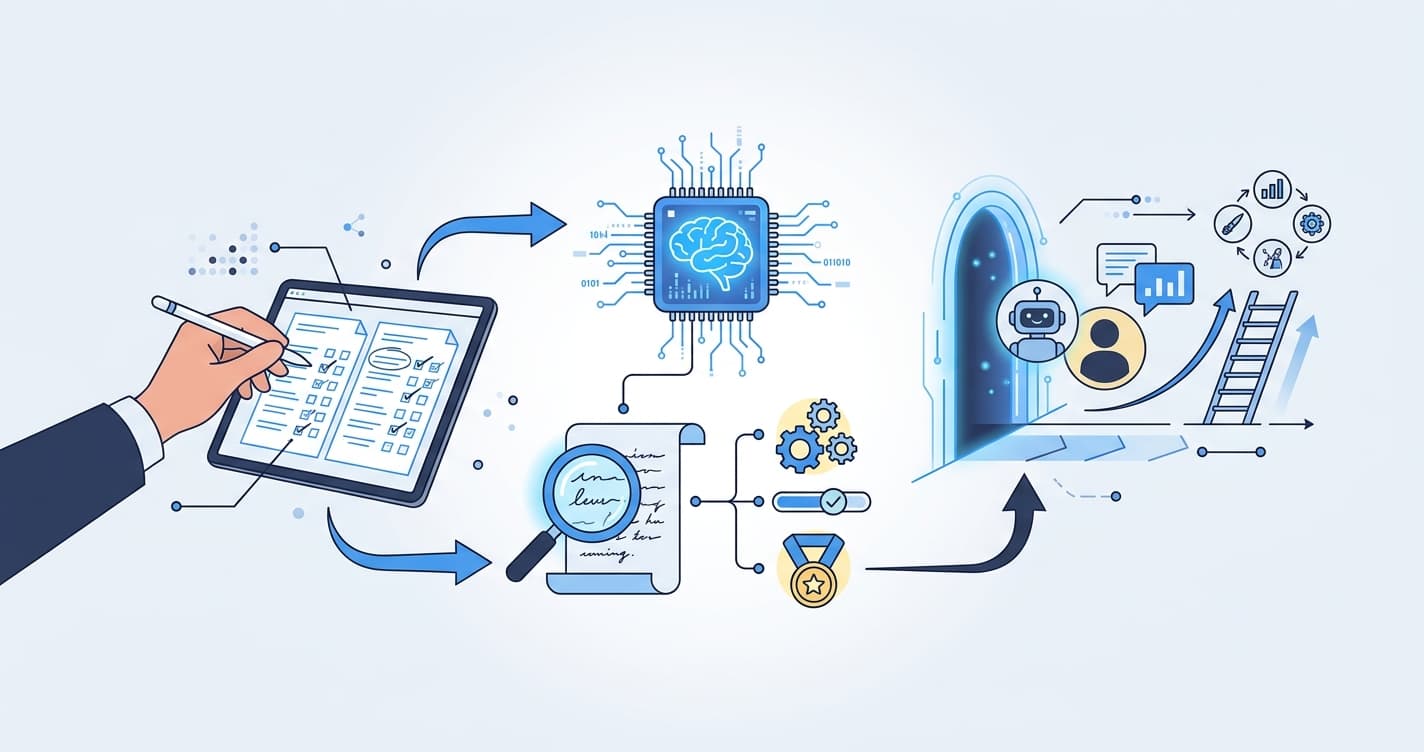
Are you struggling to keep up with the overwhelming volume of papers in your coaching centre, spending countless hours on manual grading when you could be focusing on teaching? Understanding the fundamental differences between AI grading vs digital marking is crucial for any coaching or tutoring centre looking to enhance efficiency and provide superior student feedback in India's competitive education landscape.
The Grading Burden: Why Indian Coaching Centres Need a Smarter Solution
India's coaching and tutoring centres are the backbone of competitive exam preparation, from CBSE and ICSE boards to high-stakes entrance exams like JEE and NEET. These centres often manage thousands of students across multiple batches, each submitting numerous practice papers, assignments, and mock tests weekly. The sheer volume of manual grading required is staggering, leading to immense pressure on educators, delayed feedback for students, and often, inconsistencies in evaluation.
Traditional grading methods, typically involving a large team of evaluators, are prone to human error, subjective biases, and significant time consumption. This bottleneck directly impacts a centre's ability to provide timely, actionable feedback, which is critical for student improvement and retention. Furthermore, the National Education Policy (NEP) 2020 emphasizes a shift from rote learning to competency-based assessment, demanding evaluations that gauge understanding, critical thinking, and application rather than mere memorization. This necessitates a more sophisticated and consistent approach to grading that manual methods simply cannot sustain at scale.
Digital Marking: A Step Towards Efficiency, But Not the Full Picture
Digital marking, often referred to as On-Screen Marking (OSM) or e-marking, represents an evolution from purely paper-based evaluation. In this system, answer sheets are scanned and converted into digital images, which are then distributed to human evaluators via a computer interface. The evaluators use digital tools to mark, annotate, and assign scores directly on the screen. CBSE's mandate for On-Screen Marking for Class 12 board exams from 2026 is a clear indication of this shift towards digitizing the evaluation process in India.
Benefits of Digital Marking:
- Logistical Ease: Eliminates the need to physically transport answer sheets, reducing logistics and storage costs.
- Improved Security: Digital copies are less prone to loss or damage compared to physical papers.
- Streamlined Workflow: Allows evaluators to work remotely and simultaneously, potentially speeding up the overall process.
- Centralized Record Keeping: All scores and annotations are digitally stored and easily retrievable.
However, it's crucial to understand that digital marking primarily digitizes the medium of evaluation. The core process still relies entirely on human judgment. While it addresses some logistical challenges, it doesn't fundamentally solve the issues of evaluator subjectivity, inconsistency, or the time-consuming nature of manual assessment. For a coaching centre grading hundreds or thousands of subjective papers daily, digital marking alone may not provide the transformative efficiency and insight required.
Ready to save hours on grading? Book a free demo
The Game-Changer: What is AI Grading and How Does it Work?
AI grading, or Artificial Intelligence-powered grading, goes far beyond digitizing the marking process. It leverages advanced machine learning algorithms, natural language processing (NLP), and computer vision to autonomously evaluate student responses, mimicking and often surpassing human capabilities in speed, consistency, and analytical depth. For complex subjects like Mathematics, Physics, Chemistry, or even language-based answers, AI grading can dissect responses at a granular level.
How IntelGrader's AI Grading Works:
- Digitization & OCR: Student answer sheets (handwritten or typed) are scanned or uploaded. Optical Character Recognition (OCR) technology converts handwritten text into machine-readable data.
- Model Training: The AI model is trained on a vast dataset of graded answers, learning patterns, common errors, and correct solutions. For subjective questions, it learns to identify keywords, concepts, and logical flow based on predefined rubrics and sample answers.
- Concept-Level Mapping: Unlike simple keyword matching, IntelGrader's AI understands the underlying concepts being tested. For a math problem, it doesn't just check the final answer; it maps the steps, identifies the formulas used, and pinpoints where a student might have gone wrong conceptually.
- Formula-Level Error Analysis: In numerical subjects, the AI can trace the student's working, identify incorrect formulas, calculation errors, or logical fallacies in problem-solving steps. This provides highly specific feedback.
- Automated Scoring & Feedback: Based on its analysis, the AI assigns scores according to the rubric and generates detailed, personalized feedback. This feedback highlights strengths, pinpoints exact errors, and suggests areas for improvement, far beyond a simple "correct" or "incorrect" mark.
- Learning Trajectory Creation: Over time, IntelGrader builds a profile for each student, tracking their performance across different concepts, identifying persistent weaknesses, and helping educators create personalized learning paths.
- Institutional Analytics: For multi-batch coaching centres, IntelGrader provides robust analytics on batch performance, common misconceptions across cohorts, and the effectiveness of teaching methodologies, enabling data-driven decisions.
This intelligent automation allows IntelGrader to grade 50 papers in as little as 30 minutes with 95%+ accuracy, a feat impossible with human evaluators. It frees up educators to focus on teaching, mentoring, and strategic planning, rather than repetitive grading tasks.
AI Grading vs Digital Marking: A Deep Dive into Key Differentiators
While both digital marking and AI grading leverage technology, their core functionalities and impact on the education ecosystem are vastly different. Understanding these distinctions is crucial for coaching centres aiming for true efficiency and enhanced learning outcomes.
| Feature | Digital Marking (OSM) | AI Grading (e.g., IntelGrader) |
|---|---|---|
| Core Process | Human evaluators mark digital images of papers. | AI algorithms autonomously evaluate responses. |
| Evaluation Speed | Limited by human speed; can still be slow for large volumes. | Extremely fast; grades hundreds of papers in minutes. |
| Consistency | Variable; prone to human subjectivity and fatigue. | Highly consistent; applies rubrics uniformly without bias. |
| Accuracy | Dependent on human vigilance; potential for human error. | High (95%+) and continuously improving with machine learning. |
| Feedback Quality | General comments or marks; often lacks depth. | Granular, concept-level, formula-level error analysis; personalized suggestions. |
| Learning Insights | Basic score reports; minimal actionable insights. | Identifies learning gaps, tracks mastery, suggests remedial actions, creates learning trajectories. |
| Scalability | Scalable by adding more human evaluators, which increases cost. | Highly scalable without proportional increase in human resources. |
| Resource Allocation | Educators spend significant time on repetitive marking. | Educators are freed from marking to focus on teaching, strategy, and student support. |
| Cost Efficiency | Reduces some logistical costs, but human costs remain. | Significant long-term cost savings by reducing reliance on extensive marking teams. |
| NEP 2020 Alignment | Supports digital submission, but not necessarily competency-based evaluation. | Directly supports competency-based assessment by analyzing understanding and application. |
In essence, digital marking is about making the human grading process more efficient through technology. AI grading vs digital marking highlights that AI grading is about automating and intellectualizing the grading process itself, delivering a level of detail and speed that human-centric methods, even digital ones, cannot match. For a coaching centre, this translates into not just saving hours per week but fundamentally improving the quality of education provided.
Ready to elevate your centre's evaluation process? Book a free demo
Beyond Scores: The Transformative Impact of AI Grading on Learning Outcomes
The true power of AI grading extends far beyond mere score calculation. It's a catalyst for profound improvements in student learning outcomes and operational efficiency for coaching centres. By providing immediate, detailed, and consistent feedback, AI grading transforms the learning cycle.
- Personalized Learning Paths: With concept-level error analysis, IntelGrader can identify specific areas where a student struggles. This allows educators to tailor remedial exercises, recommend targeted resources, and create truly personalized learning paths, moving away from a one-size-fits-all approach. For a student preparing for JEE or NEET, knowing exactly which sub-topic in Physics or Chemistry they need to revisit can make all the difference.
- Early Intervention: AI grading flags consistent errors or declining performance trends much faster than manual methods. This enables educators to intervene early, addressing misconceptions before they become deeply entrenched, thus preventing students from falling behind.
- Enhanced Student Engagement: Students receive feedback promptly, often within minutes of submitting their papers. This immediacy keeps them engaged, motivated, and allows them to apply corrections while the concepts are still fresh in their minds. Detailed feedback helps them understand why they got something wrong, fostering a growth mindset.
- Data-Driven Pedagogy: For coaching centre administrators, IntelGrader's institutional analytics are invaluable. It provides insights into the performance of entire batches, highlights questions where a majority of students struggled, and even evaluates the effectiveness of different teaching modules. This data empowers centres to refine their curriculum, adapt teaching strategies, and optimize resource allocation for maximum impact across all their tuition centre branches.
- Compliance with NEP 2020 Goals: The NEP 2026 advocates for assessments that are "competency-based, promote learning and development, and test higher-order skills." AI grading, with its ability to analyze understanding, application, and problem-solving steps, is perfectly aligned with these goals, helping centres prepare students not just for exams but for genuine academic growth.
Preparing for the Future: Embracing AI Grading in the Indian Education Ecosystem
The Indian education system is undergoing a significant transformation, driven by policies like NEP 2020 and technological advancements. The move towards digital evaluation, exemplified by CBSE's On-Screen Marking mandate, is just the beginning. Coaching centres that embrace AI grading now will not only future-proof their operations but also gain a significant competitive edge.
- Staying Ahead of the Curve: As the demand for quality education and personalized attention grows, centres equipped with AI grading can offer superior services. They can promise faster, more accurate feedback and a data-driven approach to student progress, attracting more students and improving retention rates.
- Optimizing Educator Resources: By automating the mundane task of grading, AI tools like IntelGrader free up experienced educators to focus on what they do best: teaching, mentoring, and developing innovative learning strategies. This leads to higher job satisfaction for teachers and better educational outcomes for students.
- Ensuring Consistency and Fairness: In a system where thousands of students are evaluated, maintaining consistency and fairness is paramount. AI grading eliminates human biases and fatigue, ensuring every student's paper is evaluated against the same objective standards, fostering trust and transparency.
- Seamless Integration with Evolving Standards: As competency-based assessments become more prevalent, AI grading platforms are uniquely positioned to adapt. Their ability to analyze complex responses based on rubrics makes them ideal for evaluating higher-order thinking skills, which are increasingly emphasized in exams like JEE Advanced and NEET.
The debate of AI grading vs digital marking isn't about choosing between technology and tradition; it's about choosing between partial and complete transformation. Digital marking offers a partial solution, while AI grading provides a comprehensive, intelligent, and scalable answer to the challenges of modern education. For Indian coaching centres, embracing AI grading is not just an upgrade; it's an imperative for sustainable growth and educational excellence.
Frequently Asked Questions about AI Grading
Can AI grading accurately evaluate subjective answers?
Yes, advanced AI grading platforms like IntelGrader utilize Natural Language Processing (NLP) and machine learning to evaluate subjective answers. They are trained on extensive datasets of correctly graded responses and rubrics, learning to identify key concepts, logical flow, contextual understanding, and even nuances in language, ensuring high accuracy for open-ended questions.
How does AI grading ensure fairness and reduce bias?
AI grading is inherently unbiased because it applies the same predefined rubrics and evaluation criteria consistently to every student's response. Unlike human evaluators who can be influenced by fatigue, mood, or unconscious biases, AI operates objectively, ensuring every paper is graded fairly and uniformly, leading to more transparent results.
Is AI grading suitable for all subjects, including complex ones like Math and Science?
Absolutely. IntelGrader's AI is specifically designed to handle complex subjects. For Math, Physics, and Chemistry, it performs formula-level error analysis, identifies incorrect steps, and pinpoints conceptual misunderstandings. For subjects requiring diagrams or graphs, computer vision capabilities can assess accuracy and completeness.
How long does it take to set up AI grading for our centre?
Setting up IntelGrader is designed to be quick and intuitive. Our team assists with initial configuration, including rubric integration and data migration. Most centres can be up and running within a few days to a week, with minimal disruption to ongoing operations. Our support team provides comprehensive training and ongoing assistance.
What about data security and student privacy with AI grading?
Data security and student privacy are paramount. IntelGrader employs robust encryption protocols, secure cloud infrastructure, and strict access controls to protect all student data. We comply with relevant data protection regulations and ensure that all information is handled with the highest level of confidentiality and integrity.
Does AI grading replace human teachers or evaluators?
No, AI grading is a powerful assistant that augments the capabilities of human educators. It automates the repetitive and time-consuming tasks of marking, freeing up teachers to focus on higher-value activities like personalized mentoring, curriculum development, and addressing individual student needs. It enhances, rather than replaces, the human element in education.
Start Grading Smarter Today
IntelGrader helps tutoring centres save 10+ hours per week with AI-powered grading. Book Your Free Demo
Ready to transform your grading?
See how IntelGrader can save your tutoring centre 10+ hours per week with AI-powered grading.