
Automated Marking Software for UK Tutors
Learn how automated marking software supports AI grading, teacher review, and clearer feedback for tutoring centres, schools, and assessment teams.
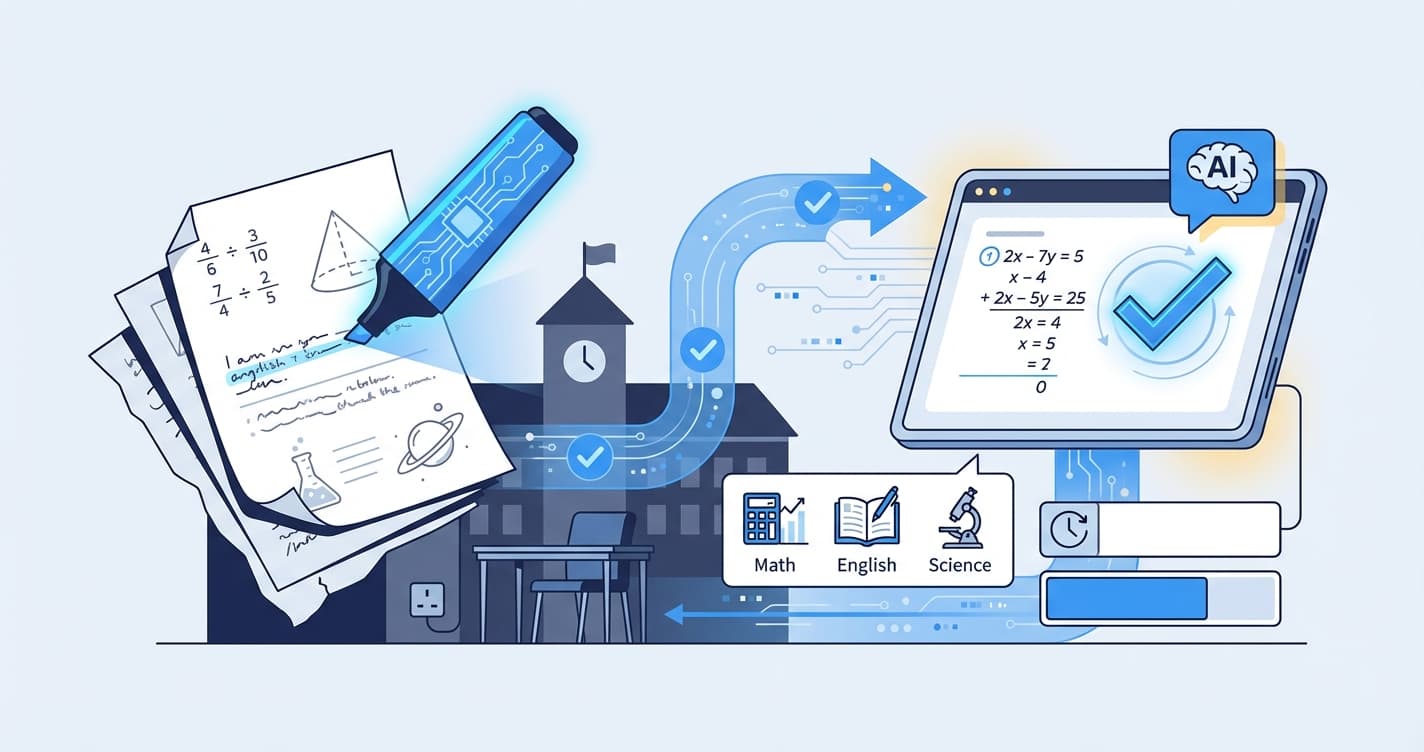
Because teams search for automated marking software, this guide keeps the workflow practical. It explains where AI helps, what teachers should review, and how to turn scoring into better student feedback.
What Is Smart Grading?
Smart grading is the use of artificial intelligence to mark student work automatically, delivering instant scores and personalised feedback without a human marker. Sometimes called smart marking or automated marking, it replaces the red pen and mark scheme with software that reads student answers — including handwritten ones — compares them against the correct solutions, and returns results in seconds.
At its core, smart grading replaces the most repetitive part of teaching: the marking pile. It does not replace the tutor. It frees the tutor to do what actually moves the needle — explaining concepts, building confidence, and adapting lessons to each learner. For UK tutoring centres handling hundreds of worksheets every week, that distinction matters enormously.
The technology behind modern smart grading combines optical character recognition (OCR), natural language processing, and machine-learning models trained on thousands of real student responses. The result is a system that can read a Year 9 student's handwritten algebra working, identify where the method went wrong, and generate targeted feedback — all before the student has packed up their pencil case.
IntelGrader is one of a growing number of AI grading UK platforms bringing smart grading to the education market. What sets it apart is its focus on handwritten maths — functioning as dedicated maths grading software built specifically for the subject that generates the largest marking burden in most tutoring centres. Rather than requiring students to type answers into a screen, IntelGrader lets them work on paper the way they would in an exam, then uses AI to grade the scanned or photographed responses.
If you have ever wondered whether there is a faster, fairer, more consistent way to mark student work, smart grading is the answer — and it is already changing how tutoring centres operate across the United Kingdom.
Why UK Tutoring Centres Need Smart Grading
The UK supplementary education sector is booming. According to the Sutton Trust, around 27 per cent of school-age children in England and Wales now receive private tutoring, a figure that has risen sharply since 2019. Tutoring centres — from high-street franchises to independent after-school programmes — are at the heart of this growth. But growth brings operational pain, and the single biggest bottleneck is marking.
The marking burden is unsustainable
Consider a mid-sized tutoring centre with 120 students attending weekly sessions in maths and English. Each student completes at least one worksheet per session. That is 240 worksheets a week that need marking, annotating, and returning. At an average of three to five minutes per worksheet, a tutor is looking at 12 to 20 hours of marking every single week — time that is either unpaid, underpaid, or stolen from lesson planning and student interaction.
Smart grading eliminates the vast majority of that workload. Worksheets that once took five minutes to mark are graded in under ten seconds. The time saved is not marginal; it is transformational.
Inconsistent feedback undermines student progress
When multiple tutors mark the same type of worksheet, inconsistencies creep in. One tutor awards half marks for method; another does not. One writes detailed corrections; another ticks and crosses. Research from the Education Endowment Foundation (EEF) highlights that the quality, not just the quantity, of feedback is one of the strongest levers for improving pupil attainment — with high-quality feedback adding up to eight months of additional progress over a year.
Smart grading delivers the same standard of feedback every time. The AI does not have an off day, does not rush through the last ten papers at midnight, and does not unconsciously favour neat handwriting over messy-but-correct working. Consistency is built into the system.
Parents expect progress reports
UK parents investing in supplementary tutoring want evidence that it is working. They want to see scores improving, gaps closing, and their child keeping pace with curriculum expectations. Historically, producing these reports has meant tutors manually logging results in spreadsheets or, worse, relying on memory.
With smart grading, every result is captured automatically. Progress dashboards let tutors and centre managers share clear, data-backed reports with parents — showing trends across weeks and months, not just a single session's score. That transparency builds trust and reduces churn.
The curriculum context: GCSE, A-level, and Key Stage expectations
UK tutoring centres operate in the shadow of some of the most high-stakes examinations in the world. Students preparing for KS2 SATs, GCSE, and A-level exams need consistent practice under conditions that mirror the real thing. That means handwritten answers, timed worksheets, and feedback aligned to the mark schemes used by exam boards such as AQA, Edexcel, and OCR.
Smart grading is particularly valuable in this context because it can be calibrated to follow specific marking criteria. For maths — the subject where IntelGrader currently operates — this means recognising valid alternative methods, awarding method marks where appropriate, and flagging common misconceptions that a student needs to address before exam day.
OFSTED and the push for personalised learning
OFSTED's inspection framework increasingly emphasises adaptive teaching and the use of assessment to inform planning. The Department for Education's own guidance encourages schools and education providers to use data to personalise learning and identify students who are falling behind. Smart grading generates exactly this kind of data. Every graded worksheet becomes a data point, and over time, patterns emerge: which topics a student consistently struggles with, which types of errors recur, and where intervention is needed.
For tutoring centres seeking to demonstrate the quality of their provision — whether to parents, to local authorities, or to OFSTED-adjacent quality frameworks — smart grading provides an evidence base that manual marking simply cannot match.
How IntelGrader's Smart Grading Works
IntelGrader has been designed as tutoring centre software that fits into the workflow centres already use. There is no need to replace your worksheets, change your curriculum, or ask students to work on tablets. The process is straightforward and built around three steps.
Step 1: Upload your worksheets
Start by uploading the worksheets your centre already uses. IntelGrader accepts PDF and image formats, so you can scan existing paper resources or export them from your worksheet library. For each worksheet, you provide the answer key — the correct answers and, for maths, the accepted methods of working.
The platform stores your worksheets in a library that your tutors can access at any time. Once a worksheet is uploaded, it can be assigned to any number of students across any number of sessions. There is no need to re-upload or reconfigure.
Step 2: Students complete their work on paper
This is the part that does not change. Students sit down, pick up a pen, and work through the questions exactly as they would in a classroom or exam hall. There is no app for the student to install, no login to remember, and no screen to distract them. They write their answers by hand on the printed worksheet.
When the student has finished, a tutor or centre administrator photographs or scans the completed paper. IntelGrader's mobile-friendly interface makes this as simple as taking a photo with a smartphone — no specialist scanning equipment required.
Step 3: AI grades the work instantly
This is where the smart grading technology takes over. IntelGrader's OCR engine reads the student's handwriting, parsing digits, mathematical symbols, and working-out steps. The AI then compares the student's responses against the answer key, awarding marks according to the criteria you have set.
Within seconds, the platform returns a fully graded worksheet. Each question is scored, and the student receives instant feedback highlighting what they got right, where they went wrong, and — crucially — what they should review next. The results are logged automatically in the student's profile, feeding into the progress tracking dashboard that tutors and parents can access.
The entire process, from photograph to graded result, typically takes less than thirty seconds. Compare that to the three to five minutes a human marker would spend on the same worksheet, and the efficiency gain becomes obvious.
For a deeper look at the technology behind handwriting recognition in education, see our article on what smart grading really means.
Key Benefits for Your Tutoring Centre
Adopting smart grading is not just about saving time — though the time savings alone justify the switch for most centres. Here is what IntelGrader delivers in practice.
Save 10+ hours per week on marking. For a centre processing 200 or more worksheets weekly, the reduction in marking time is dramatic. Those hours go back to tutors for lesson planning, one-to-one support, and professional development — or simply a healthier work-life balance.
Consistent, unbiased grading. Every worksheet is marked against the same criteria, every time. There is no variation between tutors, no unconscious bias towards presentation, and no drift in standards over the course of a long marking session. The EEF's research consistently shows that consistency in assessment is a prerequisite for effective feedback.
Instant feedback for students. Students learn best when feedback is immediate. A correction received thirty seconds after finishing a worksheet is far more useful than one returned three days later, by which point the student has forgotten the context. Smart grading closes the feedback loop in real time, while the work is still fresh.
Progress tracking for parents and tutors. Every graded worksheet contributes to a longitudinal record of student performance. Tutors can identify trends, spot recurring weaknesses, and adjust their teaching accordingly. Parents can see clear evidence of progress — or early warning signs that additional support is needed. This data-driven approach aligns with the DfE's emphasis on using assessment to inform personalised learning.
Works for maths, with more subjects coming soon. IntelGrader currently supports maths worksheets across the full range of UK key stages, from KS2 arithmetic through to A-level calculus. Support for additional subjects, including English and science, is on the roadmap.
No change to your existing workflow. Students still write on paper. Tutors still choose the worksheets. The only thing that changes is who — or what — does the marking.
Scalable as your centre grows. Adding more students to a tutoring centre traditionally means adding more marking hours. With smart grading, the marginal cost of grading an additional worksheet is effectively zero. Growth no longer means tutor burnout.
These benefits compound over time. A centre that adopts smart grading today is not just more efficient next week; it is structurally better positioned to grow, retain staff, and deliver measurable outcomes for every student.
Smart Grading vs Traditional Marking
To make the comparison concrete, here is how IntelGrader's smart grading stacks up against the traditional manual approach across the metrics that matter most to tutoring centre operators.
| Feature | Traditional Marking | IntelGrader Smart Grading |
|---|---|---|
| Time per worksheet | 3–5 minutes | Under 30 seconds |
| Consistency | Varies by marker, time of day, and fatigue | Identical criteria applied every time |
| Feedback speed | Hours to days after submission | Instant — results within seconds |
| Feedback quality | Depends on individual tutor's annotations | Structured, specific, and actionable |
| Progress tracking | Manual spreadsheet entry (if done at all) | Automatic, with dashboards and trend analysis |
| Cost per paper | Tutor time at £12–25/hour | Fraction of the manual cost at scale |
| Scalability | Linear — more papers means more hours | Near-zero marginal effort per additional paper |
| Bias and fairness | Subject to unconscious marker bias | Objective, criteria-based assessment |
The table tells a clear story: smart marking is faster, more consistent, and more scalable than the traditional approach. But it is worth emphasising that the goal of automated marking is not to eliminate tutors from the process. The goal is to eliminate the drudge work so that tutors can focus on high-value activities — the kind of adaptive, responsive teaching that no algorithm can replicate.
For a detailed comparison of IntelGrader against other automated grading platforms, including Gradescope and similar tools, see our comparison page.
Who Uses Smart Grading?
Smart grading is not a niche technology for large institutions. It is designed to be practical and accessible for the full range of supplementary education providers operating across the UK.
Tutoring centres
High-street and community tutoring centres are the primary users of smart grading. These organisations typically serve between 50 and 500 students per week, with maths as the dominant subject. The marking burden scales directly with student numbers, making AI grading the single most impactful operational improvement a centre can make. Whether your centre follows a franchise model or operates independently, smart grading fits into your existing processes with minimal disruption.
After-school clubs and homework centres
Many schools and community organisations run after-school programmes that include structured worksheet practice. These programmes are often staffed by teaching assistants or volunteers who may not have the subject expertise to mark every paper with confidence. Smart grading removes that pressure, ensuring that every worksheet is assessed accurately regardless of who is supervising the session.
Supplementary schools
The UK has a rich tradition of supplementary schools — weekend and evening programmes run by community groups, faith organisations, and cultural associations. These schools are frequently under-resourced, with volunteer staff donating their time. Smart grading is particularly valuable here because it delivers professional-quality assessment without requiring professional marking capacity. A supplementary school that adopts IntelGrader can offer the same standard of feedback as a fully staffed private tutoring centre.
Private tutors
Individual tutors working one-to-one or with small groups also benefit from smart grading, though the time savings are proportionally smaller. Where private tutors gain the most is in progress reporting. Parents paying £30 to £60 per hour for private tuition expect detailed updates on their child's performance. IntelGrader's analytics dashboard makes it trivially easy to share data-backed progress summaries, turning an awkward end-of-term conversation into a clear, evidence-based review.
Coaching institutes
In the broader context of global education, coaching institutes — large-scale tutoring operations common in South Asia and increasingly present in the UK — face marking challenges at an entirely different order of magnitude. A coaching institute preparing hundreds of students for competitive examinations can generate thousands of worksheets per day. At that scale, manual marking is not just inefficient; it is physically impossible without an army of markers. Smart grading is the only viable solution for organisations operating at this volume.
Getting Started with IntelGrader
Bringing smart grading into your tutoring centre is straightforward. There are no lengthy onboarding processes, no hardware to install, and no minimum contract periods required to get started.
Step 1: Book a demo
The best way to understand what IntelGrader can do for your centre is to see it in action. Our team will walk you through the platform, demonstrate the OCR grading on real handwritten worksheets, and answer your questions about accuracy, data security, and integration with your existing workflow. The demo takes around 20 minutes and can be conducted remotely via video call.
Step 2: Upload your first worksheets
Once you are set up, uploading your worksheets takes minutes. If you already have digital versions of your resources (PDFs, scanned images), you can have your first worksheet ready for grading the same day. Our team can also help you digitise paper-based resources if needed.
Step 3: Start grading
Assign worksheets to your students, collect their completed papers, photograph or scan the responses, and let the AI do the rest. Most centres report that their tutors are fully comfortable with the workflow within a single session.
The time you reclaim from marking can be reinvested immediately — in better lesson planning, more one-to-one support, or simply ensuring your tutors are not burning out under the weight of an unsustainable workload.
Ready to see smart grading in action? Book a free demo and find out how much time your centre could save.
Frequently Asked Questions
What subjects does IntelGrader support?
IntelGrader currently supports maths across all UK key stages, from KS2 through to A-level. This includes arithmetic, algebra, geometry, statistics, and calculus. Our AI is trained on the types of questions and mark schemes used in preparation for SATs, GCSE, and A-level examinations. Support for additional subjects is in active development, with English and science planned for future release. For now, if maths marking is your biggest time sink — as it is for the majority of UK tutoring centres — IntelGrader addresses that challenge directly.
Can AI really read handwritten maths?
Yes. IntelGrader uses advanced optical character recognition (OCR) specifically trained on handwritten mathematical notation. The system can read digits, algebraic expressions, fractions, equations, and working-out steps written by students of all ages. Handwriting varies enormously between students, and our OCR models have been trained on a wide variety of handwriting styles to handle this diversity. The system is not limited to neat, textbook-perfect writing — it is designed for the real, sometimes messy handwriting that students produce under timed conditions.
How accurate is AI grading?
IntelGrader's grading accuracy is comparable to that of experienced human markers. In internal testing, the system achieves agreement rates with human graders that meet or exceed the inter-marker reliability typically observed between two human markers assessing the same paper. Where the AI is uncertain about a handwriting interpretation or an unusual method of working, it flags the response for human review rather than guessing. This means you can trust the automated results while retaining oversight for edge cases. Accuracy continues to improve with every update to our models.
Is my student data secure?
Absolutely. Data security is a foundational requirement for any technology used in education, and IntelGrader takes it seriously. All student data is encrypted in transit and at rest. The platform is hosted on infrastructure that complies with UK data protection requirements, including the UK General Data Protection Regulation (UK GDPR) and the Data Protection Act 2018. We do not sell or share student data with third parties. You retain full ownership of your data, and you can request deletion at any time. For centres with specific compliance requirements, our team can provide a detailed data processing agreement.
How much does smart grading cost?
IntelGrader offers flexible pricing tailored to the size and needs of your tutoring centre. Rather than publishing a one-size-fits-all price list, we prefer to understand your specific volume, workflow, and requirements so we can recommend the right plan. To get a personalised quote, book a demo with our team. During the call, we will discuss pricing in detail and ensure you have a clear picture of the costs and expected return on investment. What we can say is that even a modest reduction in marking hours typically covers the cost of the platform several times over.
Do students need a device or app?
No. Students complete their work on paper with a pen or pencil, exactly as they would in a normal lesson or exam. There is no student-facing app, no login, and no screen time involved. The only technology required is a smartphone or scanner to capture the completed worksheet, and that is handled by the tutor or centre administrator — not the student. This is a deliberate design choice. We believe that for handwritten practice to be effective exam preparation, students should be working in conditions that mirror the exam itself.
How long does it take to set up IntelGrader?
Most tutoring centres are up and running within a single day. The setup process involves creating your account, uploading your worksheets and answer keys, and familiarising your tutors with the photograph-and-grade workflow. There is no software to install on centre computers, no hardware to purchase, and no IT department required. If you can take a photo on a smartphone, you can use IntelGrader.
The Future of Marking Is Here
The UK tutoring sector is growing, and with that growth comes an unavoidable scaling challenge: more students means more worksheets, and more worksheets means more marking. For decades, the only solution was to hire more markers or ask existing tutors to work longer hours. Smart grading breaks that equation.
With IntelGrader, a tutoring centre of any size can deliver fast, fair, and consistent assessment without increasing headcount or burning out staff. The AI handles the repetitive work. The tutors handle the teaching. The students get faster feedback. The parents get clearer progress reports. Everyone wins.
The Education Endowment Foundation's Teaching and Learning Toolkit identifies feedback as one of the most cost-effective interventions for improving student outcomes. But feedback only works if it is timely, specific, and consistent — qualities that are difficult to maintain when a single tutor is marking 50 worksheets at 11 PM on a Tuesday night. Smart grading makes high-quality feedback the default, not the exception.
Whether you run a small tutoring practice from your front room or manage a multi-site operation with hundreds of students, IntelGrader's smart grading platform is built to make your marking faster, fairer, and fundamentally more sustainable.
Book your free demo today and see what smart grading can do for your tutoring centre.
Related IntelGrader resources
Related IntelGrader resources
Ready to transform your grading?
See how IntelGrader can save your tutoring centre 10+ hours per week with AI-powered grading.