
AI Grading Canada for Tutoring Centres
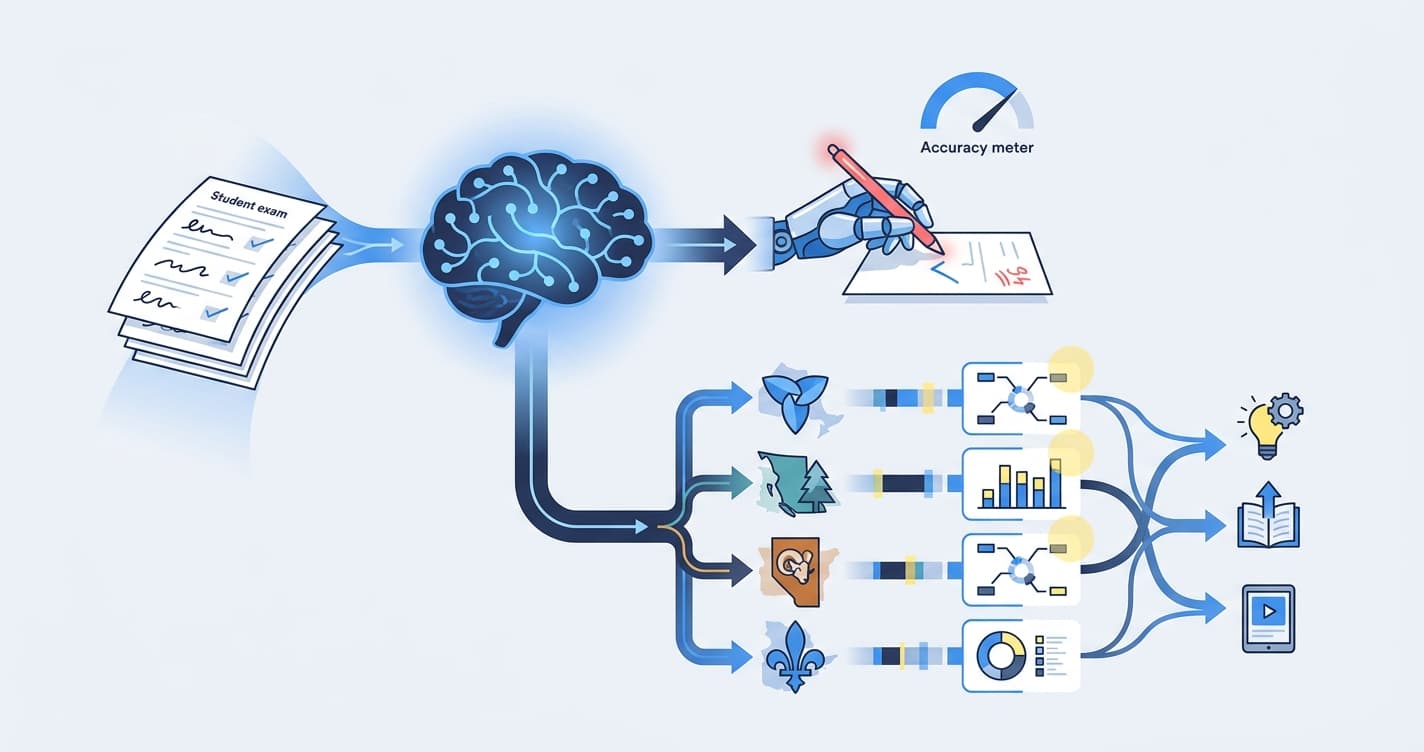
Because teams search for ai grading canada, this guide keeps the workflow practical. It explains where AI helps, what teachers should review, and how to turn scoring into better student feedback.
AI Grading for Canadian Tutoring Centres: How Analytics Drive Next Steps
Why Canadian tutoring centres are looking at AI grading
The Canadian tutoring market grew strongly through 2024–2025, driven by post-pandemic learning gap recovery and parent demand for measurable progress reporting. Tutors and centres face a familiar pain: marking handwritten work and producing per-student feedback consumes 6–10 hours per tutor per week.
AI grading addresses the marking. The diagnostic and remediation layers address the planning.
What Canadian centres specifically need
- Provincial curriculum alignment — Ontario, BC, Alberta, Quebec, Manitoba have different frameworks
- Bilingual (English/French) handling — required for Quebec, Ontario French-immersion, and New Brunswick
- PIPEDA + Quebec Law 25 compliance — student data must be handled correctly
- Canadian-spelling support — "centre", "colour", "favour" should not trigger false errors
A generic US-trained AI grader gets the math right but trips on the spelling and curriculum specifics.
Subjects and grade levels AI grading handles well
| Level | Strong subjects | Notes |
|---|---|---|
| Grade 4–8 | Math, English, Sciences | Provincial frameworks well-documented |
| Grade 9–12 | Math, English, Sciences, French | HSC/AP equivalents readily marked |
| University prep | Math, Sciences, essay-based courses | Rubric-driven assessment |
The analytics that matter
In 2026, the conversation has moved past "Can AI grade?" to "What does the AI tell you that a tutor can't?" Three categories of insight:
- Per-student concept gaps — which specific topics each student keeps missing
- Batch-level patterns — which concept was confusing for the whole class
- Trend analytics — is the student improving, plateauing, or sliding?
A tutor with 20 students can't track all three manually. AI surfaces them in seconds.
From score to next step — the remediation loop
The actionable output isn't the score. It's the next-step recommendation the AI generates:
- "Maya keeps missing fraction-to-decimal conversion — assign these 3 problems before Friday"
- "Three students in the batch missed Q4 — re-teach proportional reasoning at the start of next session"
- "Ethan's essays are weak on evidence selection — suggest the Grade 10 evidence-citation worksheet"
A platform without this layer leaves the tutor to do the analytics manually. A platform with it cuts lesson-prep time to near-zero.
Privacy and compliance
Canadian centres must check four things before adopting any AI grading tool:
- Data residency — is student work stored in Canada (or has explicit cross-border consent been collected)?
- No-training opt-out — vendor must not train future models on submitted work without explicit permission
- PIPEDA-compliant policies documented and shared with parents
- Quebec Law 25 compliance if any centre handles Quebec students
If the vendor can't tell you where data sits in plain English, that's the answer.
What it costs
Canadian centres in 2026 typically pay:
- Solo tutor / under 50 students: C$60 – C$150/month
- Small centre (50–200): C$150 – C$400/month
- Mid-size (200–600): C$400 – C$900/month
GST/HST/QST is on top of the base rate.
The pilot method
A two-week pilot gives a real read:
- Week 1: Run one batch through AI grading alongside your manual marking. Read both outputs.
- Week 2: Use AI's next-step recommendations to plan your second batch's session.
If the second-batch session feels easier to plan and the students respond to the targeted feedback, the tool earns its price.
Book a demo for a walk-through tailored to your provincial curriculum.
FAQ
Does AI grading support Canadian provincial curricula?
The best platforms align to Ontario, BC, Alberta, and Quebec frameworks specifically. Generic US-trained AI gets math right but misses provincial-specific marking conventions for English Language Arts and Social Studies.
Is AI grading compliant with PIPEDA?
Reputable platforms store data in Canada (or offer explicit cross-border consent), don't train models on student work without opt-in, and publish PIPEDA-aligned privacy policies. Quebec centres also need Law 25 compliance.
Can AI grade French Language Arts essays?
Yes — but only with platforms calibrated on French-language student writing. Most US-built platforms can score French essays but miss the cultural and curricular nuances that Quebec markers use.
What does AI grading cost in Canada?
Solo tutors under 50 students: C$60–150/month. Small centres (50–200): C$150–400. Mid-size (200–600): C$400–900. GST/HST/QST is on top of the base rate.
How long does Canadian onboarding take?
Most centres are up and running within 48 hours, with full provincial-curriculum calibration in the first 2–4 weeks. Plan for a 2-week pilot before committing to a full rollout.
Related IntelGrader Resources
Ready to transform your grading?
See how IntelGrader can save your tutoring centre 10+ hours per week with AI-powered grading.