AI Tutoring UK: Marking, Feedback, and Growth

How AI Is Transforming UK Tutoring: A Comprehensive Guide
AI tutoring UK is no longer a futuristic concept discussed in academic papers — it is a practical reality reshaping how tutoring centres operate, how students learn, and how educators spend their time. Artificial intelligence is being deployed across the UK supplementary education sector to automate grading, personalise learning pathways, generate instant feedback, and provide data-driven insights that were impossible to produce manually. For tutoring centre owners and educators, understanding where AI is delivering real value today — and where it is heading tomorrow — is essential for making informed decisions about technology adoption.
This guide examines the current state of the UK tutoring market, explores the specific ways AI is being applied in tutoring, analyses the impact on grading and assessment, discusses the challenges and limitations, and looks at what the future holds for AI tutoring UK providers and the students they serve.
The State of UK Tutoring in 2026
The UK supplementary education sector has grown dramatically over the past decade, driven by a combination of parental demand, post-pandemic catch-up needs, and increasing pressure from high-stakes examinations at GCSE and A-level.
Market size and growth
According to the Sutton Trust's research, approximately 27 per cent of school-age children in England and Wales now receive some form of private tutoring — a figure that has risen steadily since their 2019 survey and accelerated during the COVID-19 pandemic. The market includes high-street tutoring centres, independent after-school programmes, online tutoring platforms, supplementary schools, and individual private tutors.
The National Tutoring Programme (NTP), launched in 2026 to address pandemic-related learning loss, further legitimised and expanded the supplementary education market. While the NTP's government funding has been scaled back, the infrastructure and demand it created remain. Parents who discovered tutoring during the pandemic have continued to invest in it.
Industry estimates suggest the UK private tutoring market is valued at over £2 billion annually, with growth rates of 8-12 per cent per year. That growth brings opportunity — but also operational challenges that technology must address.
The operational challenge
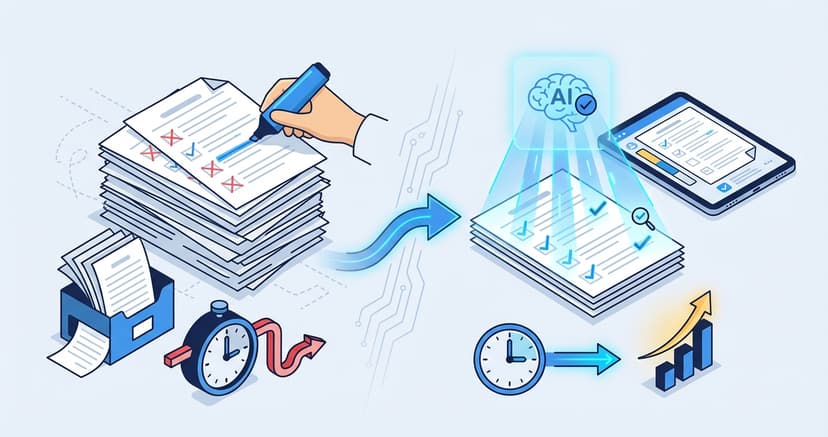
Growth in student numbers creates a proportional increase in operational burden. More students means more worksheets, more marking, more progress tracking, more parent communication, and more administrative overhead. For tutoring centres relying on manual processes, this growth hits a ceiling: the point at which the marking burden becomes unsustainable without hiring additional staff.
This is the fundamental tension that AI resolves. By automating the most time-consuming, repetitive elements of tutoring centre operations — particularly grading and assessment — AI allows centres to scale without proportionally increasing their headcount or burning out their existing tutors.
The staffing challenge
The UK is experiencing a well-documented shortage of qualified teachers and tutors. The Department for Education's workforce statistics show persistent recruitment and retention challenges, particularly in maths and science. For tutoring centres competing for the same talent pool, this means every hour of unnecessary administrative work — including manual marking — makes the job less attractive to potential hires and harder to sustain for existing staff.
AI-powered tools directly address this by removing the most tedious aspects of the role. A tutor who spends their time teaching, mentoring, and supporting students — rather than marking papers at midnight — is a tutor who stays in the profession longer.
AI Applications in UK Tutoring
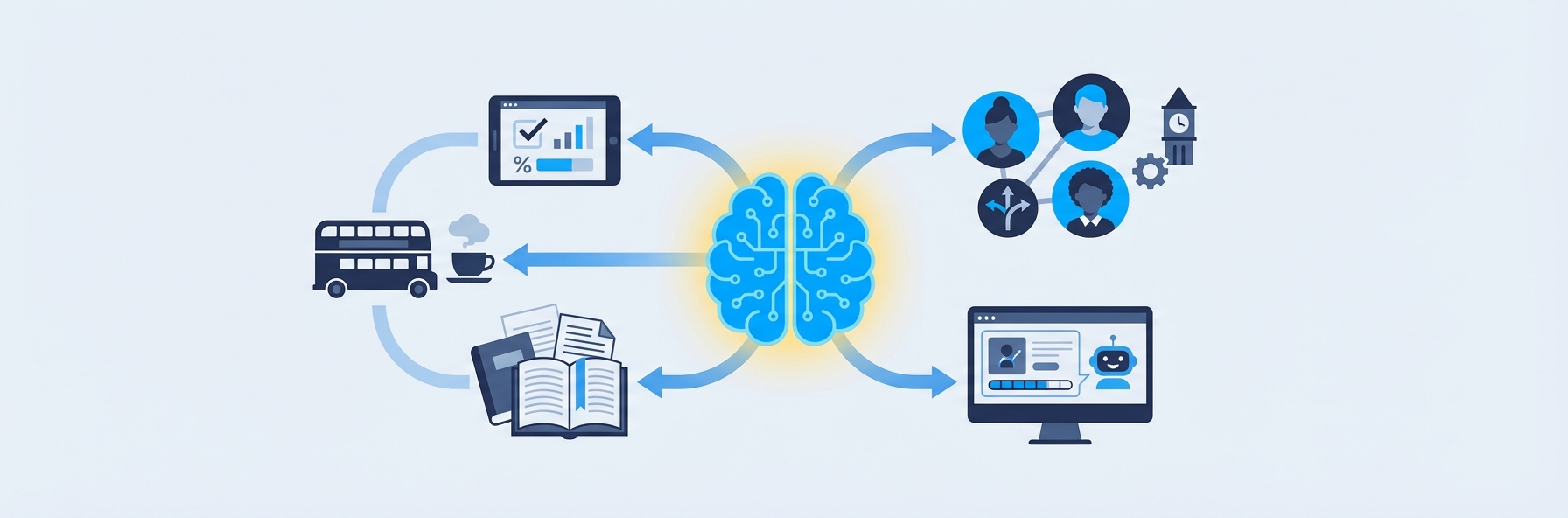
AI is not a single technology. It is a collection of capabilities that can be applied across different aspects of the tutoring workflow. Here are the areas where AI is having the most significant impact on AI tutoring UK operations today.
1. Automated grading and assessment
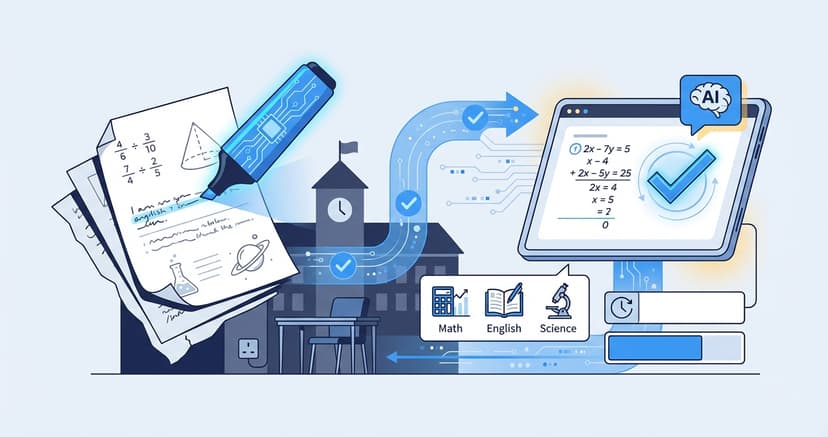
Automated grading is the most mature and immediately impactful application of AI in UK tutoring. Platforms like IntelGrader use optical character recognition (OCR) and machine learning to read handwritten student work, evaluate answers against marking criteria, and return scored results with personalised feedback — all within seconds.
This is not the bubble-sheet scanning of previous decades. Modern AI grading reads free-form handwritten mathematical notation: digits, algebraic expressions, fractions, working-out steps, and spatial relationships between symbols. It evaluates multi-step solutions, awards partial credit for correct method with incorrect arithmetic, and generates specific feedback explaining what the student got right and where they went wrong.
For UK tutoring centres, the impact is transformational:
- Time savings: A centre processing 200 worksheets per week saves 10-15 hours of marking time. Those hours are returned to tutors for teaching, planning, and student support.
- Consistency: Every paper is marked against identical criteria. No inter-marker variability, no fatigue effects, no unconscious bias.
- Speed: Students receive feedback in seconds, not days. Research from the Education Endowment Foundation consistently identifies timely, specific feedback as one of the most powerful levers for improving pupil attainment.
- Data generation: Every graded worksheet becomes a data point, feeding into progress tracking that informs personalised teaching and transparent parent reporting.
For a detailed look at how AI grading compares to traditional marking, read our full analysis of smart grading vs traditional marking.
2. Personalised learning pathways
Beyond grading, AI is increasingly being used to tailor learning content to individual students. The principle is straightforward: if the system knows which topics a student struggles with (from grading data), it can recommend or generate practice materials targeting those specific weaknesses.
In the UK context, this is particularly valuable for exam preparation. A student preparing for GCSE maths who consistently loses marks on simultaneous equations needs more practice on that topic — not another generic revision worksheet covering material they have already mastered. AI can identify these gaps automatically and suggest targeted interventions.
Some platforms are moving towards adaptive learning systems that adjust difficulty in real time based on student performance. While this technology is still maturing, the foundation — granular performance data from AI grading — is already available through platforms like IntelGrader.
The Department for Education's guidance on personalised learning aligns closely with this approach: using assessment data to identify individual needs and adapt teaching accordingly. AI makes this practical at scale, whereas doing it manually for every student in a busy tutoring centre is effectively impossible.
3. Intelligent progress analytics
One of the most underappreciated applications of AI in tutoring is the analytics layer it enables. When every worksheet is graded automatically and the results are stored in a structured database, patterns become visible that would be invisible to manual observation.
Student-level insights: Which topics does a specific student consistently struggle with? Are they improving over time or plateauing? Which error types recur — arithmetic slips, method errors, or conceptual misunderstandings? This granularity enables tutors to make evidence-based decisions about lesson planning.
Class-level insights: Which topics are causing difficulty across the whole group? Is a particular worksheet too easy or too hard? Are students progressing at the expected rate for their year group and target grade? These insights help centre managers evaluate the effectiveness of their curriculum and teaching methods.
Business insights: What is the centre's student retention rate? Are students who attend more frequently showing better progress (justifying the upselling of additional sessions)? Which tutors are producing the strongest student outcomes? When backed by data, these decisions become objective rather than gut-feel.
For UK tutoring centres, this data also serves a critical commercial function: parent communication. Parents investing in private tutoring want evidence that it is working. AI-generated progress dashboards — showing scores, trends, and topic-level performance over time — provide this evidence automatically, without additional administrative effort.
4. Administrative automation
Beyond the core teaching and learning workflow, AI is streamlining the administrative side of running a tutoring centre. This includes:
- Automated scheduling: AI-assisted tools that optimise tutor timetables, manage room allocation, and handle rebooking when sessions are cancelled.
- Parent communication: Automated progress reports, session reminders, and payment notifications that reduce the administrative burden on centre staff.
- Financial management: AI-powered forecasting tools that predict cash flow based on enrolment trends, session frequency, and seasonal patterns.
These applications are less mature than AI grading in the specific context of tutoring centres, but they represent the next wave of operational efficiency. Platforms that combine assessment automation with administrative tools — like tutoring management software — are increasingly attractive to centre owners who want a unified operational platform.
Grading Automation: The Biggest Immediate Impact
Of all the AI applications in UK tutoring, grading automation delivers the largest and most immediate return on investment. This is worth examining in detail because it is the entry point for most centres adopting AI.
Why grading is the bottleneck
In a typical UK tutoring centre, the core workflow is: students arrive, complete worksheets, and leave. The worksheets then need marking, the results need recording, and feedback needs returning. This marking cycle is the single largest consumer of tutor time outside of actual teaching hours.
A centre with 120 students attending twice per week generates approximately 240 worksheets per week. At 4 minutes per worksheet, that is 16 hours of marking — unpaid or underpaid hours that often happen late at night, at weekends, and at the expense of tutors' personal time and wellbeing.
Manual marking is also the weakest link in the feedback chain. Research consistently shows that feedback is most effective when it is timely and specific. But in a traditional workflow, feedback arrives days after the student completed the work — too late to correct misconceptions while the material is fresh.
How AI grading solves it
Smart grading platforms like IntelGrader replace the manual marking step entirely for structured maths worksheets. The tutor photographs or scans the completed paper, submits it to the platform, and receives a fully graded result with question-by-question feedback within seconds.
The student gets feedback immediately. The data is logged automatically. The progress dashboard updates in real time. The tutor's evening is free.
For centres considering this technology, the practical question is not "does AI grading work?" — it does, and it has been proven across thousands of UK tutoring centre worksheets. The question is "how quickly can we implement it and what will the impact be?" For most centres, the answer is: within a day, and the impact is measured in hours reclaimed per week from the first week.
To explore how smart grading fits into your centre's workflow, book a free demo and test it with your own worksheets.
Personalised Learning: The Next Frontier

While grading automation is the most mature AI tutoring UK application, personalised learning represents the highest-potential area of AI in education.
What personalised learning means in practice
True personalised learning goes beyond simply grouping students by ability. It means understanding each student's specific strengths, weaknesses, learning pace, and error patterns — and adapting the teaching and practice materials accordingly.
In a traditional tutoring centre, this personalisation depends entirely on the tutor's memory, intuition, and available time. A good tutor might notice that one student keeps making sign errors in algebra, but tracking this systematically across 50 or 100 students, week after week, is beyond what any human can manage reliably.
AI changes this equation. When every worksheet is graded automatically and the results are stored in a structured format, the platform can identify patterns that would take a human hours of manual analysis to spot:
- Student A loses marks on fractions in 7 out of the last 10 worksheets — this is not a one-off error but a persistent gap.
- Student B's algebra scores have improved steadily over 6 weeks but their geometry scores are declining — a shift in teaching focus is needed.
- The entire GCSE group struggles with probability questions — this is a curriculum issue, not an individual student issue.
From data to action
The next step — moving from insight to action — is where AI-driven personalisation becomes truly powerful. Some platforms are beginning to offer:
- Automated practice recommendations: Based on grading data, the system suggests specific worksheets or question types that target a student's weakest areas.
- Adaptive difficulty: Questions become harder or easier based on the student's demonstrated mastery, keeping them in the optimal learning zone.
- Predictive alerts: The system flags students who are at risk of falling behind based on performance trends, enabling early intervention rather than reactive crisis management.
These capabilities are still emerging, but the foundations are being laid today by the data that AI grading platforms generate. Centres that adopt AI grading now are building the dataset that will power personalised learning features tomorrow.
AI chatbots and virtual tutors
Looking further ahead, conversational AI — the technology behind ChatGPT and similar systems — is being adapted for educational use. AI chatbots that can answer student questions, explain concepts step by step, and guide students through practice problems are a natural extension of the automated grading workflow.
These tools are not ready to replace human tutors, and they may never be. But as supplementary resources — available when the tutor is not — they have significant potential. A student who gets stuck on a homework problem at 9 PM could ask an AI tutor for a hint, try the problem again, and submit it for AI grading, all without needing to wait until the next tutoring session.
For UK tutoring centres, the strategic implication is clear: investing in AI grading infrastructure today positions your centre to adopt personalisation and conversational AI features as they mature, because you will already have the data, the workflows, and the operational habits in place.
Case Studies: AI in Action Across UK Tutoring
While specific customer case studies require permission that is beyond the scope of this article, the following scenarios represent common patterns observed across UK tutoring centres adopting AI.
Scenario 1: The high-street maths centre
A tutoring centre in Manchester with 180 students and six part-time tutors adopted AI grading for their GCSE and A-level maths worksheets. Within the first month, they reduced weekly marking time from 18 hours to under 3 hours (handling time for scanning only). The tutors used the reclaimed time for small-group revision sessions that the centre previously could not offer due to time constraints. Parent satisfaction scores increased measurably once automated progress reports replaced verbal updates.
Scenario 2: The multi-site franchise
A tutoring franchise operating four centres across the West Midlands implemented AI grading to standardise assessment quality across sites. Previously, each centre's tutors marked independently, leading to inconsistent grading standards and difficulty comparing student performance across locations. With AI grading, every worksheet at every centre is marked against the same criteria. The franchise owner can now view a unified analytics dashboard showing performance trends across all 600+ students, enabling data-driven decisions about curriculum, staffing, and resource allocation.
Scenario 3: The solo private tutor
An independent maths tutor in London working with 22 students one-to-one adopted AI grading not primarily for time savings (the absolute hours saved were modest) but for the data. Parents paying £50-65 per hour expected detailed, evidence-based progress updates. The tutor's previous approach — handwritten notes and mental recall — could not satisfy this expectation. With AI grading generating structured performance data for every session, the tutor now shares monthly progress dashboards with parents, leading to higher retention rates and a steady stream of referrals.
These scenarios illustrate a consistent pattern: AI grading delivers value at every scale, but the nature of the value shifts depending on the centre's size, structure, and priorities.
Challenges and Limitations of AI in Tutoring

An honest assessment of AI tutoring UK must address the limitations and challenges alongside the benefits.
Accuracy on non-standard content
AI grading is most accurate on structured, well-defined question types — arithmetic, algebra, equation solving, and standard curriculum content. Questions involving diagrams, graph interpretation, or unusual formats may require human review. The best platforms flag low-confidence responses rather than guessing, but centres should not expect 100 per cent automation on every worksheet from day one.
Subject limitations
The strongest AI grading platforms currently specialise in mathematics. Subjects requiring subjective judgement — English literature essays, creative writing, open-ended science investigations — are at a different stage of AI maturity. Centres whose primary workload is in humanities or creative subjects will find less immediate value from current AI grading technology, though the field is advancing rapidly.
Data privacy and security
Any technology that processes student data must comply with UK data protection regulations, including the UK General Data Protection Regulation (UK GDPR) and the Data Protection Act 2018. Centres adopting AI tools should verify that their chosen platform encrypts data in transit and at rest, does not sell or share student data with third parties, and can provide a data processing agreement. IntelGrader, for example, is designed with these requirements as foundational — not afterthoughts.
Change management
Introducing AI tools into a tutoring centre requires managing the human side of change. Tutors may worry about job security, be sceptical about AI accuracy, or resist altering their established workflow. The most successful implementations address these concerns directly: demonstrating that AI handles the marking (not the teaching), running pilot projects that build confidence in accuracy, and involving tutors in the transition rather than imposing it.
Cost considerations
While AI grading typically delivers a strong return on investment, the subscription cost is a real expense that smaller centres must budget for. The financial case is strongest for centres processing high volumes of worksheets (150+ per week), where the labour cost saving is substantial. For very small operations, the value proposition may rest more on data quality and parent communication than on raw time savings.
Digital infrastructure
AI grading requires a smartphone or scanner to capture completed worksheets, a reliable internet connection, and basic digital literacy among staff. For the vast majority of UK tutoring centres, these requirements are trivially met. In rare cases — particularly for community-run supplementary schools operating in low-resource environments — the digital infrastructure requirement may be a barrier.
The Future of AI in UK Tutoring
The trajectory of AI tutoring UK is clear: more automation, more personalisation, and deeper integration of AI into every aspect of the tutoring workflow.
Near-term (2026-2027)
- Expanding subject coverage: AI grading will extend beyond maths to science, physics, and chemistry notation, and eventually to structured written responses in English and humanities.
- Deeper personalisation: Platforms will move from reactive analytics (showing what happened) to proactive recommendations (suggesting what to do next), with AI-generated practice sets targeting individual student weaknesses.
- Improved handwriting recognition: Each generation of OCR models handles a wider range of handwriting styles with greater accuracy, reducing the percentage of submissions that require human review.
Medium-term (2027-2029)
- Conversational AI tutors: AI chatbots that can explain maths concepts, guide students through problem-solving steps, and answer questions in natural language will become practical supplementary tools for tutoring centres.
- Predictive analytics: Platforms will predict which students are at risk of underperforming in upcoming exams based on performance trends, enabling earlier and more targeted intervention.
- Simulation and interactive assessment: AI-driven simulations that test conceptual understanding through interactive scenarios — not just static worksheets — will begin to complement traditional paper-based practice.
Long-term (2029+)
- Fully adaptive learning systems: AI that continuously adjusts the difficulty, topic, and format of practice materials in real time based on each student's demonstrated mastery, creating a truly individualised learning experience.
- AI-assisted curriculum design: Tools that help tutoring centres design their curriculum based on aggregate student data, exam board requirements, and evidence of what teaching approaches produce the best outcomes.
- Multimodal AI: Systems that combine visual understanding (handwriting), audio understanding (spoken explanations), and text understanding (typed responses) into a unified assessment framework.
For centre owners, the strategic takeaway is this: the AI capabilities available today — particularly automated grading — are the foundation upon which these future capabilities will be built. Centres that adopt AI grading now are not just solving today's marking problem. They are building the data infrastructure and operational habits that will enable them to adopt tomorrow's personalisation and adaptive learning tools when they arrive.
What This Means for UK Tutoring Centre Owners
The practical implications of AI's transformation of UK tutoring can be summarised in five points.
1. Start with grading. Automated grading is the lowest-risk, highest-impact entry point for AI adoption. It solves an immediate, measurable problem (the marking burden) and generates the data that powers every other AI application. Platforms like IntelGrader are purpose-built for this use case in the tutoring centre context.
2. The competitive landscape is shifting. Centres that adopt AI tools will be able to offer faster feedback, better progress tracking, and more transparent parent communication than those that do not. As parent expectations rise, these capabilities will shift from "nice to have" to "table stakes."
3. Your tutors will thank you. Removing the marking burden is one of the most effective things a centre owner can do for staff retention and job satisfaction. Tutors who entered the profession to teach — not to mark papers at midnight — will appreciate the change.
4. Data is the new competitive advantage. The centres that build the largest, most structured datasets of student performance will be best positioned to offer personalised learning, predictive analytics, and evidence-based outcomes reporting. AI grading generates this data as a byproduct of its primary function.
5. The cost of inaction is growing. Every week a centre delays AI adoption is a week of unnecessary marking hours, delayed feedback, inconsistent grading, and manual data entry. The opportunity cost compounds over time.
To see how AI grading works in practice and understand what it could mean for your centre, book a free demo of IntelGrader.
For a deeper exploration of the technology behind AI grading, see our complete guide to smart grading for UK tutoring centres.
Frequently Asked Questions
Is AI tutoring legal in the UK?
Yes, there are no laws prohibiting the use of AI in tutoring or education in the UK. The relevant legal framework concerns data protection: any AI tool that processes student data must comply with the UK General Data Protection Regulation (UK GDPR) and the Data Protection Act 2018. This means obtaining appropriate consent, processing data lawfully, ensuring security, and respecting the rights of data subjects (students and parents). Reputable AI tutoring platforms like IntelGrader are designed to meet these requirements, including data encryption, secure hosting, and clear data processing agreements. The UK government has actively encouraged the responsible use of AI in education, and the Department for Education's guidance supports the use of technology to improve teaching and assessment.
Will AI replace tutors in the UK?
No. AI is replacing the most repetitive, low-value parts of a tutor's job — primarily marking and data entry — not the tutor themselves. The skills that define effective tutoring — explaining concepts, building confidence, adapting to a student's emotional state, providing motivation and accountability — are fundamentally human capabilities that AI cannot replicate. What AI does is free tutors from the administrative burden that prevents them from doing more of this high-value work. The most effective deployment treats AI as a powerful assistant that handles the volume so the tutor can handle the nuance. Centres that adopt AI grading consistently report that tutor satisfaction improves because the role becomes more focused on teaching and less on clerical tasks.
How much does AI tutoring technology cost?
Costs vary significantly depending on the specific tools, the scale of your operation, and the capabilities you need. AI grading platforms like IntelGrader offer flexible pricing tailored to individual centre requirements — the best way to understand costs is to book a demo and discuss your specific needs. What can be said generally is that for centres processing 100+ worksheets per week, the cost of an AI grading platform is typically a small fraction of the annual marking labour cost it replaces. The return on investment comes from reduced marking hours, improved tutor retention (less burnout-related turnover), automatic progress tracking (eliminating manual data entry), and improved parent communication (reducing churn). Most centres find the platform pays for itself within the first month of operation.
What data does AI collect about students, and is it safe?
AI grading platforms collect the data necessary to grade student work and track progress: images of completed worksheets, graded results, scores, and performance trends over time. Reputable platforms like IntelGrader encrypt all data in transit and at rest, comply with UK GDPR requirements, and do not sell or share student data with third parties. Centres retain full ownership of their data and can request deletion at any time. When evaluating any AI tutoring platform, ask for their data processing agreement, confirm their hosting location and security certifications, and verify their compliance with UK data protection law. The key principle is that student data should be used solely to improve the educational service provided to that student — nothing more.
How do I get started with AI in my tutoring centre?
The most practical first step is to adopt AI grading for your highest-volume subject — typically maths. Choose a platform designed for tutoring centres (not universities or schools, which have different workflows and requirements). Upload your existing worksheets and answer keys. Run a one-week pilot with a single group of students, comparing AI-graded results against what a human marker would have produced. Once you are confident in the accuracy and workflow, expand to additional groups and subjects. The entire process, from first demo to centre-wide rollout, typically takes one to two weeks. Most centres start by booking a demo to see the platform in action with their own materials before committing. From there, the transition is straightforward — no new hardware, no IT department, and no disruption to how students work.
Sources
The Sutton Trust (2019). Private Tuition Polling 2019. Available at: https://www.suttontrust.com/our-research/private-tuition-polling-2019/
Education Endowment Foundation (2023). Teaching and Learning Toolkit: Feedback. Available at: https://educationendowmentfoundation.org.uk/education-evidence/teaching-learning-toolkit/feedback
Department for Education (2026). School Workforce in England 2026. Available at: https://explore-education-statistics.service.gov.uk/find-statistics/school-workforce-in-england
Hattie, J. (2009). Visible Learning: A Synthesis of Over 800 Meta-Analyses Relating to Achievement. Routledge.
House of Commons Education Committee (2023). The Future of Post-16 Qualifications. Available at: https://committees.parliament.uk/committee/203/education-committee/
Ready to transform your grading?
See how IntelGrader can save your tutoring centre 10+ hours per week with AI-powered grading.